Project Breathe: Home monitoring trials for people with chronic respiratory conditions
Co-funding UK-wide trials with the Department of Health and Social Care, led by researchers at Royal Papworth Hospital NHS Foundation Trust, to explore whether AI and at-home monitoring technology can help people living with chronic respiratory conditions manage their health.

Overview
Project Breathe aims to give patients with cystic fibrosis (CF) and bronchiectasis greater control over their health and a better understanding of when they are showing early signs of deterioration or exacerbation. Patients receive home monitoring devices and take frequent readings that would previously have been taken only during annual check-ups.
Home monitoring devices include:
- activity monitor – tracks daily steps, heart rate, and more
- pulse oximeter – measures oxygen levels in the blood
- spirometer – measures how much air can be breathed in and out
- weight scales
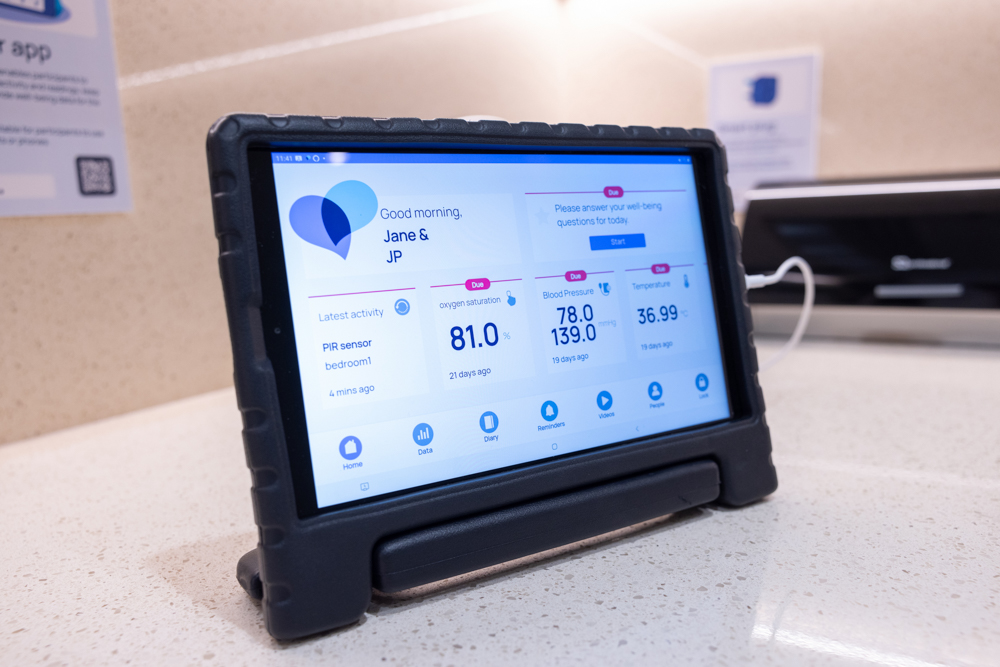
The data is uploaded instantly to a smartphone app called Breathe-RM, allowing clinicians and nurses to review progress remotely and at appointments. The collected data also feeds into machine learning algorithms, developed by scientists at the University of Cambridge, to support predictive analysis.
The app is designed to work as an early warning system by letting participants know if an infection could be developing up to 10 days earlier. This means patients can remain well at home or be called in to receive treatment before symptoms begin, reducing the chances of hospital admissions and further damage to their lungs.
The initial work received funding from the CF Foundation and was supported by the CF Trust.
Trials we’ve co-funded as part of Project Breathe:
ACE-CF: Artificial intelligence to control acute pulmonary exacerbations in cystic fibrosis
ACE-CF was designed to test an AI-driven feature in the Breathe RM app, called Breathe RM Signal. Its purpose is to predict exacerbations and help reduce unnecessary routine hospital visits for people living with CF.
Participants use special equipment to measure key indicators such as blood oxygen levels, lung function, weight and heart rate every day. Results are then uploaded via the Breathe RM app, and specially-trained AI algorithms use this data to identify early signs of infection.
Participants can view a simple, colour-coded risk score on the app, along with clear instructions on any actions to take.
If ACE-CF is successful in helping detect early signs of exacerbations, it could help this technology become more widely available to people with CF. This could improve quality of life and deliver substantial cost and time savings for the NHS.
ACE-CF is co-funded by us and the National Institute for Health and Care Research (NIHR) and sponsored by Royal Papworth NHS Foundation Trust. We worked closely with these partners to develop the study. We hope to provide expertise for the technology’s onward development.
Results are expected in the first half of 2026.
Bronch-EX: Early detection of pulmonary exacerbations in non-cystic fibrosis bronchiectasis
Bronch-EX is an observational study involving 50 participants with non-CF bronchiectasis. It aims to assess whether data from the home monitoring devices, combined with an AI-driven predictive algorithm and the Breathe RM app, can identify pulmonary exacerbations before symptoms appeared.
The use of non-invasive, easy-to-use equipment could potentially enable faster interventions and treatment to reduce long-term lung damage.
Results are expected in early 2026.
ASM in CF: ANNE sensor monitoring in cystic fibrosis
The ANNE Chest Sensor is a small wireless device that attaches to the chest with an adhesive patch and measures biometrics such as heart and breathing rates.
ASM in CF is an observational pilot study at Royal Papworth Hospital involving 10 patients already enrolled in Project Breathe. It is a sub-study of Bronch-EX.
It is exploring whether the sensor could assist or improve the detection of health conditions in people with CF, focusing on the onset and progression of pulmonary exacerbations. The study also assesses how well the device is tolerated by participants and explores its potential use in clinical practice.
Results are expected in early 2026.
Impact of Project Breathe
People living with chronic lung conditions like CF and bronchiectasis frequently experience exacerbations – a worsening of symptoms often involving chest infections that can further damage their lungs. These can require hospital stays that can last weeks or months, severely disrupting daily life.
This technology could change that. By detecting early signs of infection before symptoms appear, patients can start treatment sooner, reducing hospital admissions and preventing significant lung damage. In the future, this technology could also benefit people with other chronic lung conditions such as chronic obstructive pulmonary disease (COPD) and asthma, paving the way for more proactive, personalised care.
Contact us
This site is protected by reCAPTCHA and the Google privacy policy and terms apply.